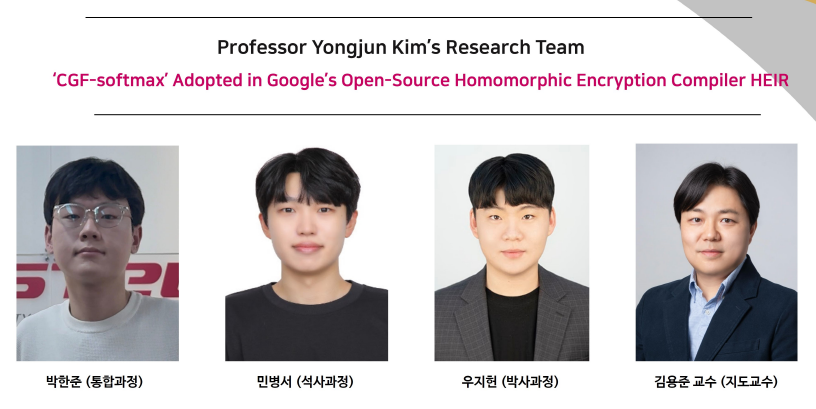

CGF-softmax, developed by Professor Yongjun Kim’s research team in the Department of Electrical Engineering at POSTECH, has been implemented as a compiler feature that transforms existing softmax operations into CGF-softmax computations in Google’s open-source homomorphic encryption compiler project, HEIR. The feature was included in the August 2026 release.
CGF-softmax is a technique for efficiently computing softmax, an operation widely used in neural networks, when performing AI computations on encrypted data. Since homomorphic encryption uses addition and multiplication as its basic operations, implementing the division required for softmax and the maximum operation used for numerical stability incurs substantial computational costs. The team developed a method that uses the statistical properties of data to approximate softmax without either operation, improving computational efficiency while maintaining high inference accuracy in large language models (LLMs) and vision transformers. The feature incorporated into HEIR automatically transforms a program’s existing softmax operations into CGF-softmax computations.
This implementation is significant because the team’s algorithm has moved beyond research papers and experiments to become a transformation feature in a global open-source compiler, making it reusable by other researchers and developers.
Students Hanjun Park, Byeongseo Min, and Jiheon Woo contributed as authors, with Professor Yongjun Kim serving as the corresponding author. This research was supported by LG Electronics.